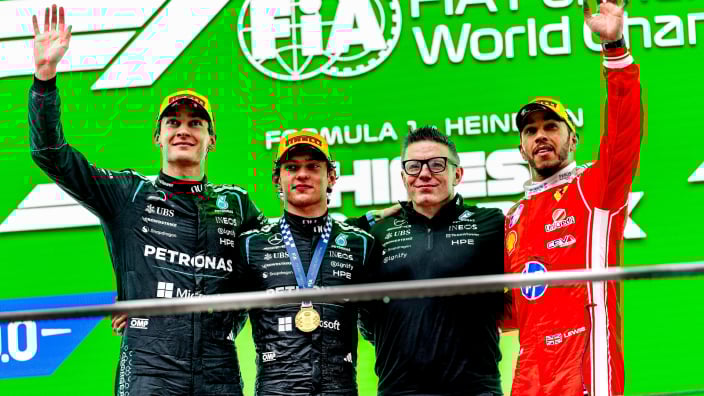
Seventy-two points. That’s what Kimi Antonelli has after three races, which puts the 19-year-old Mercedes driver at the top of the world championship standings. Read that sentence again and let it settle in your brain alongside everything else that feels impossible about 2026.
Two wins from his last two starts. Pole position at both China and Japan. The youngest driver to ever lead a Formula 1 championship. And crucially, nine points clear of his own team mate George Russell, who was supposed to be the senior partner in this relationship.
Mercedes have started 2026 with a perfect three-from-three record on race wins, but the internal dynamics at Brackley are shifting faster than their active aero wings on the Suzuka straights.
Russell’s radio complaints
The cracks showed at Suzuka. Antonelli had stretched his first stint to lap 22, gambling on track position while Russell pitted early for the undercut. Standard strategy divergence between team mates — until Oliver Bearman’s 50G crash at Turn 13 brought out the Safety Car at precisely the wrong moment for Russell’s race.
Antonelli pitted under yellow flags, emerged in the lead, and cruised to his second consecutive victory. Russell, meanwhile, spent the remainder of the race complaining about timing on the radio with the kind of barely-contained frustration that suggests this conversation will continue in the debrief room.
'This is unbelievable. Every time we split strategies, the Safety Car comes out at the exact moment that helps the other car.'
— George Russell, lap 25
We found this written on a napkin in the McLaren hospitality.
The mathematics of racing luck are cruel and random, but Russell’s frustration runs deeper than one poorly-timed yellow flag. He won the season opener in Australia while Antonelli finished second. Three weeks later, their positions have reversed in both individual races and the championship table.
The changing narrative
Mercedes arrived at the 2026 season with carefully managed expectations about their driver pairing. Russell was the established race winner, the proven quantity, the driver who would guide Antonelli through his sophomore campaign. Antonelli was the prodigy, the long-term project, the future of the team.
The future, it turns out, arrived ahead of schedule.
Antonelli’s pole lap at Shanghai — 1:32.064 — made him the youngest driver to ever start a Grand Prix from P1. His victory the following day made him the youngest to win consecutive races. His championship lead makes him the youngest to top the standings after three rounds.
These aren’t just statistical curiosities. They represent a fundamental shift in how Mercedes view their driver hierarchy, and more importantly, how Russell views his own position within the team.
What the numbers reveal
Strip away the narrative drama and focus on the raw performance data. Antonelli has qualified ahead of Russell in two of the three races so far. He’s finished ahead in the two races where both cars saw the chequered flag. His average qualifying position is 1.7; Russell’s is 2.0.
The gap in race pace is minimal — Russell actually set faster fastest laps in both Australia and Japan — but Antonelli has maximized his opportunities while Russell has encountered the kind of strategic misfortune that can define championship campaigns.
More telling is the energy management data from Suzuka. The 2026 regulations demand precise electrical deployment throughout each stint, and Antonelli’s battery usage patterns show the kind of mature race craft that typically takes years to develop. His ability to extend the first stint while maintaining competitive lap times suggests an intuitive understanding of the new hybrid systems that even seasoned drivers are still learning.
The bigger question
Mercedes now face a familiar problem from an unfamiliar angle. They have the fastest car on the grid and two drivers capable of winning races, but only one can win the championship. The difference this time is that their designated number two is currently their number one.
Russell has been professional in public, offering the expected platitudes about team success and learning from each other. But radio messages don’t lie, and his frustration at Suzuka revealed a driver who recognizes that his window of opportunity might be closing faster than expected.
For Antonelli, the pressure shifts from “prove you belong” to “prove you can handle leading.” Championship leaders face different scrutiny, different expectations, different tactical considerations from rival teams. The target on his back just grew considerably larger.
The next challenge comes at Miami in four weeks’ time, where sprint weekend format adds another layer of complexity to an already volatile situation. Can Antonelli maintain his momentum? Can Russell find the strategic luck that has eluded him so far? Can Mercedes manage two title contenders without destroying their team unity?
Seventy-two points after three races. In a 24-race season, that’s a strong start but hardly decisive. The championship fight is far from over, but the narrative has already been written: the teenager is no longer learning from the veteran. The veteran is chasing the teenager.