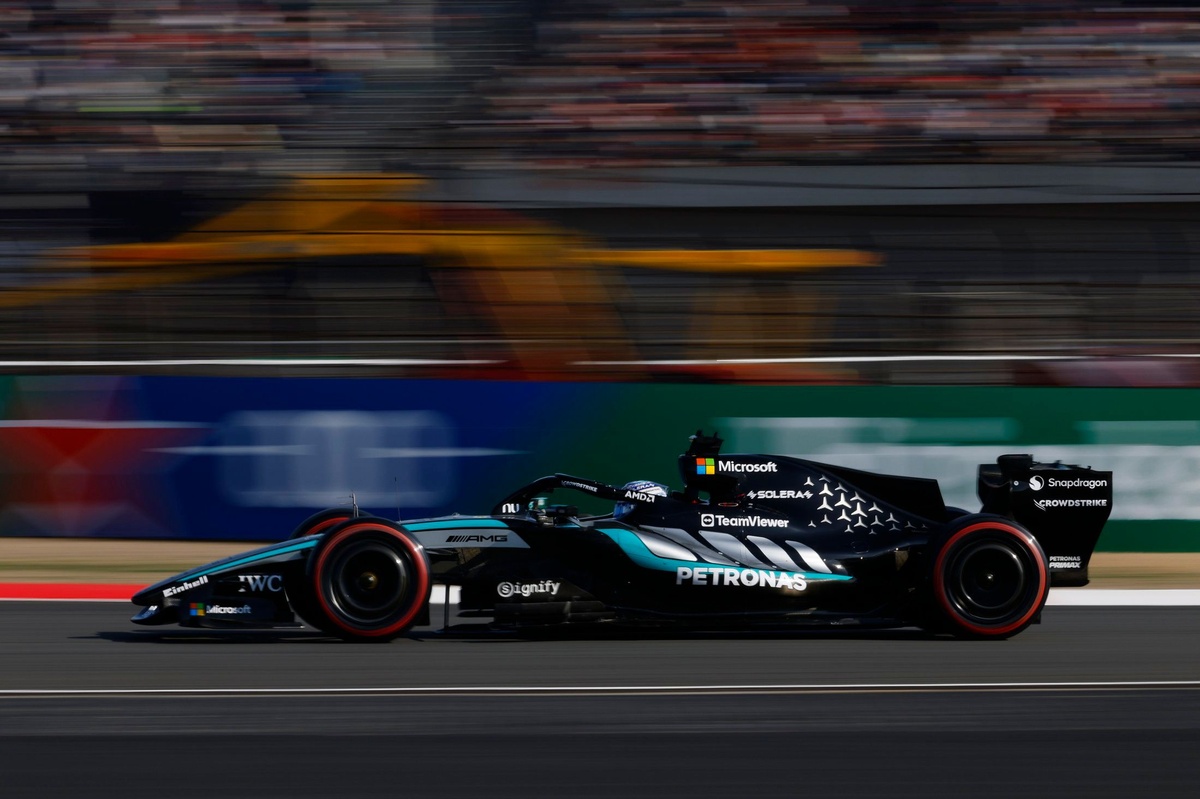
There’s something almost poetic about a team being so comprehensively illegal that they have to turn themselves in. Mercedes, fresh off Kimi Antonelli’s maiden victory in China and sitting pretty at the top of both championships, have decided that honesty is indeed the best policy when your car might be breaking half the technical regulations.
The Silver Arrows admitted ahead of this weekend’s Japanese Grand Prix that “something was amiss” with their W17 following the Shanghai race. Not the kind of admission you typically hear from a team that’s just secured a 1-2 finish and extended their championship lead to 31 points over Ferrari.
Damage Control or Death Wish?
Most teams, when they suspect their car might be bending the rules, tend to keep quiet and hope the FIA’s technical scrutineers are having an off day. Mercedes have taken the opposite approach: voluntary confession before anyone’s even asked the question.
It’s the automotive equivalent of walking into a police station to report your own speeding ticket. Admirable in its transparency, baffling in its timing.
'Toto, we've got a problem. And I don't mean the usual kind of problem.'
— Mercedes engineer, Tuesday morning debrief
Reconstructed from memory. And by memory, we mean imagination.
The FIA has now opened a full technical investigation into the W17’s compliance with the 2026 regulations. Given that these are the most complex rule changes in F1 history—active aerodynamics, massively increased electrical power, entirely new energy management systems—there are approximately seventeen thousand ways a car can be illegal this season.
Mercedes apparently found one of them.
What’s at Stake
If the investigation concludes that the W17 was indeed non-compliant during the Chinese Grand Prix, the consequences could be severe. Disqualification from the race would strip Antonelli of his maiden victory and cost Mercedes 44 points in the constructors’ championship—nearly half their current total.
More significantly, it would hand that victory to George Russell, promoting Lewis Hamilton to second and Charles Leclerc to third. Ferrari would suddenly find themselves within striking distance in both championships, and Hamilton would have his first Ferrari win rather than just his first Ferrari podium.
The timing couldn’t be more awkward for Mercedes. They’ve looked utterly dominant through the first two races, with their mastery of the new active aerodynamics and energy management systems giving them a clear advantage over the field. Russell and Antonelli have been in a class of their own, making everyone else look like they’re driving different cars.
The Honesty Question
What makes this situation genuinely fascinating is Mercedes’ decision to self-report. In a sport where teams routinely push every boundary and exploit every loophole, voluntary admission of wrongdoing is about as common as Verstappen admitting his car is too fast.
There are two ways to read this move. Either Mercedes discovered something so obviously illegal that they knew the FIA would inevitably find it, making a preemptive confession their best chance at leniency. Or they’ve made a calculated decision that transparency now is worth more than the points they might lose.
The cynical interpretation is that Mercedes found something catastrophically wrong and realized that being caught would be worse than confessing. The optimistic view is that they’ve chosen integrity over results, prioritizing their long-term reputation over short-term championship points.
Both readings suggest the same thing: whatever they found was significant enough to risk their entire season over.
The FIA’s investigation will likely take several days, with a verdict expected before the Japanese Grand Prix weekend concludes. Until then, Mercedes will compete under the shadow of potential disqualification, knowing that every point they score might be temporary.
For Antonelli, the situation is particularly cruel. At 19, he’s already shown remarkable composure and speed in his second F1 season. His China victory was a masterclass in pressure management, converting pole position into a dominant win while his more experienced teammate followed him home. To lose that maiden victory to a technical infringement would be heartbreaking, regardless of whether he had any role in the car’s non-compliance.
The broader implications extend beyond Mercedes. If the investigation reveals fundamental issues with how teams are interpreting the new regulations, it could trigger a wave of technical clarifications that reshape the competitive order. Other teams will be frantically checking their own cars, wondering if they’ve missed something obvious.
What we’re witnessing is either remarkable corporate responsibility or the most expensive bout of conscience in motorsport history. Either way, Mercedes have ensured that their dominance comes with an asterisk—one they put there themselves.