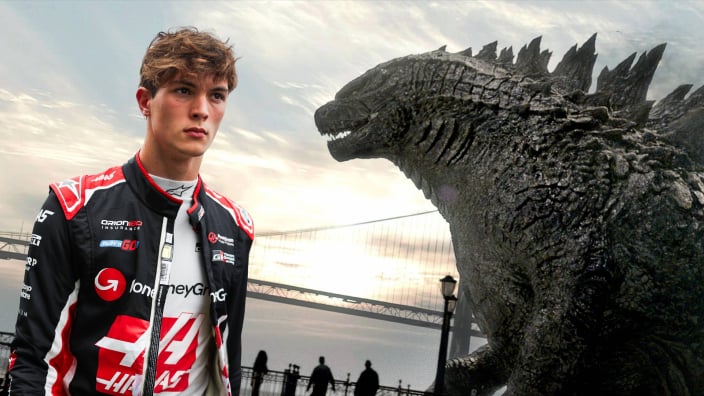
P4 in the constructors’ championship. Oliver Bearman sitting fifth in the drivers’ standings. And now this — a Godzilla livery that makes every other car on the grid look like rental fleet vehicles.
Haas F1 Team have finally remembered something the rest of the paddock forgot years ago: people watch motorsport because it’s supposed to be spectacular.
The livery, unveiled this morning in the Suzuka paddock, transforms their VF-26 into something that belongs in a kaiju movie rather than a corporate boardroom. Deep metallic scales run along the sidepods. Atomic blue highlights trace the halo and front wing. The rear wing carries Godzilla’s distinctive silhouette against a burning Tokyo skyline.
Gene Haas stood beside the car grinning like a man who’d just remembered why he got into this sport in the first place.
Performance Meets Personality
Timing matters in Formula 1. Drop this livery during their usual midfield struggles, and it becomes a meme about polishing turds. Debut it when you’re genuinely quick, and suddenly you’re the team everyone wants to root for.
The numbers back up the spectacle. Bearman’s P5 in China wasn’t a fluke — the kid carved through traffic like he’d been racing at this level for years, not months. Esteban Ocon might be pointless on paper, but his China penalty came from actually fighting for positions rather than circulating anonymously in P14.
More importantly, their Ferrari power unit isn’t exploding. In an era where Red Bull engines are question marks and McLaren cars won’t start, reliability becomes the ultimate performance differentiator.
'Ayao, the car looks incredible. Can we keep this forever?'
— Oliver Bearman, first practice session
The Corporate Courage Problem
For too long, F1 liveries have been designed by committees terrified of offending sponsors who probably don’t watch races anyway. Every surface gets divided between logo placements. Every color choice gets focus-grouped into beige mediocrity.
Meanwhile, Haas just painted a giant monster on their car and called it Tuesday.
The Japanese Grand Prix provides perfect cover for this kind of creative risk. Local fans appreciate the cultural reference. International audiences get something worth screenshotting. And if the performance stays strong, this becomes the livery everyone remembers from 2026.
Compare this to Aston Martin’s continued commitment to making their cars look like expensive lawn equipment, or Alpine’s determination to prove that blue and pink can somehow look boring together. Even Ferrari, with all their history and mystique, basically paint their cars red and call it heritage.
What Happens Next
One weekend doesn’t make a season, but momentum matters in Formula 1. Teams that feel good about themselves make better decisions. Drivers with confidence take better risks. Engineers working on something they’re proud of find those extra tenths.
Suzuka will test whether Haas can maintain their early-season form on a circuit that exposes every weakness. The track’s high-speed corners and elevation changes demand aerodynamic precision their VF-26 hasn’t faced yet. Active aero systems that worked in Shanghai’s long straights might struggle with Suzuka’s flowing esses.
But here’s what matters more than lap times: Haas finally looks like a team worth caring about. In a season where Mercedes dominates, McLaren breaks down, and Red Bull struggles with their new engine, the American team has created something genuinely exciting.
The Godzilla livery isn’t just paint and vinyl. It’s a statement that Formula 1 can be both fast and fun, competitive and creative, serious about racing while still remembering why people fall in love with this sport in the first place.
Friday practice starts in six hours. For the first time in years, everyone will be watching to see how the Haas performs — not just because Bearman might score points, but because they actually want to see that car succeed.
Revolutionary concept, really. Making people care.