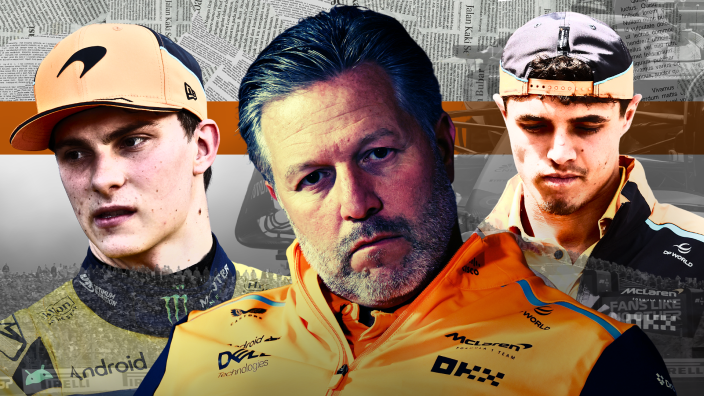
Eighteen points. That’s what the defending constructors’ champions have managed to scrape together from the opening two rounds of 2026, a figure so modest it wouldn’t buy you a decent lunch in the McLaren Technology Centre cafeteria. Yet there they all were this week, summoned to Woking like schoolchildren called to the headmaster’s office, as Zak Brown’s voice echoed through the gleaming corridors with what sources describe as “rallying cry” energy.
The numbers tell a story that even McLaren’s famously optimistic communications department would struggle to spin. Piastri crashed on his way to the grid in Melbourne—at his home race, no less—while both cars suffered electrical failures that kept them parked in China. When your most reliable performance comes from not starting at all, you know the season has taken an interesting turn.
The Gathering Storm
The emergency meeting wasn’t just about crisis management; it was about identity crisis management. This is the team that outfoxed Red Bull throughout 2025, the outfit that turned Lando Norris into a world champion and made Oscar Piastri look like the natural heir to the throne. Now they’re watching Oliver Bearman in a Haas collect more points than their entire operation, which feels like the automotive equivalent of being outrun by someone wearing wellington boots.
Brown’s message, according to those present, centered on returning to fundamentals—the kind of engineering discipline that built their 2025 success. The new regulations have clearly caught McLaren off guard, with their Mercedes power unit integration seemingly at odds with their aerodynamic philosophy. It’s the sort of technical mismatch that can turn championship-winning cars into very expensive paperweights.
'The data doesn't lie—we've got fundamental issues with energy recovery in the new recharge zones'
— Andrea Stella, McLaren Team Principal
What Went Wrong
The 2026 regulation changes have exposed every team’s true engineering DNA, and McLaren’s appears to be having an existential crisis. The shift to 50/50 power split between internal combustion and electrical systems has created an entirely new discipline of energy management, one that Mercedes has mastered while their customer teams flounder.
McLaren’s struggles aren’t just about hardware—they’re about adaptation. The active aerodynamics that replaced DRS require a completely different approach to setup philosophy, and the narrower, shorter cars demand precision that their current package simply doesn’t possess. When Norris finished sixth in Australia, it felt like damage limitation. When both cars failed to start in China, it felt like capitulation.
The irony is almost poetic: the team that spent 2025 perfecting the art of strategic brilliance now finds itself outmaneuvered by the regulations themselves. Energy recovery zones that should be harvesting power are instead highlighting their deficiencies, while their rivals—particularly Mercedes and Ferrari—demonstrate mastery of systems McLaren helped pioneer during their championship run.
The Path Forward
Credit where it’s due: Brown’s decision to gather the troops shows leadership rather than panic. This isn’t a team throwing blame around a boardroom; it’s an organization acknowledging that their current trajectory leads nowhere good. The meeting reportedly focused on technical solutions rather than personnel changes, suggesting they believe the talent is there but the execution isn’t.
Andrea Stella’s engineering team faces a monumental challenge. They need to fundamentally rewire their approach to energy management while simultaneously solving reliability issues that have cost them two race starts already. It’s the kind of multi-dimensional problem that separates the great teams from the good ones—and McLaren’s championship credentials are about to be thoroughly examined.
The season is young, but in Formula 1, momentum is everything. Mercedes has built theirs through dominance; McLaren needs to build theirs through recovery. The difference between those two trajectories often determines who lifts trophies in December and who spends the winter wondering what might have been.