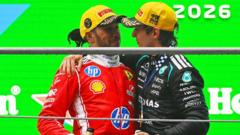
Lap 58 of the Chinese Grand Prix. Lewis Hamilton crosses the line in third place, his first Ferrari podium, and the radio crackles with something we haven’t heard in months: genuine joy. Not relief. Not professional satisfaction. Joy.
The seven-time world champion climbs from his SF-26, removes his helmet, and there’s something different in his eyes. Something that wasn’t there during the painful learning curve of 2025, when every weekend felt like a masterclass in public struggle.
Now a former British F1 driver is suggesting the secret ingredient behind Hamilton’s 2026 renaissance isn’t found in Ferrari’s wind tunnel data or their mastery of the new energy deployment systems. It’s considerably more analog than that.
“There’s love in the air,” the unnamed insider told reporters, presumably with the straightest face possible. “Lewis looks like a man who’s found something worth fighting for again.”
The Numbers Don’t Lie (But They Don’t Tell the Whole Story)
The statistical evidence is compelling. Hamilton sits fourth in the championship with 33 points after two races — already half his total from the opening stint of 2025. His qualifying performances have jumped from consistently scraping into Q3 to genuine front-runner pace. At Shanghai, he was just 0.3 seconds off pole position.
More telling is the body language. The Hamilton of late 2025 looked like someone carrying the weight of expectations that had curdled into resignation. The Hamilton of 2026 bounces into the paddock with a spring in his step that hasn’t been seen since his Mercedes championship years.
'The car feels alive again. Everything just... clicks.'
— Lewis Hamilton, post-race China
Ferrari’s technical director refuses to attribute the improvement to anything as frivolous as romantic entanglements. “Lewis has adapted brilliantly to our energy management philosophy,” he insists. “The new regulations suit his driving style perfectly.”
Which is probably true. But it doesn’t explain why Hamilton was photographed leaving a trendy Milan restaurant last week with someone who definitely wasn’t discussing brake balance over dessert.
The Ferrari Factor vs The Heart Factor
Here’s the thing about elite-level motorsport: the margins between victory and mediocrity are measured in tenths of seconds and fractions of percentage points. When everything else is optimized to the limit of physics and regulation, the human element becomes the differentiating factor.
Hamilton’s 2025 season at Ferrari was technically competent but emotionally flat. He learned the car, adapted to the team culture, and posted respectable results. But there was no spark, no transcendent moments that reminded you why he’s considered one of the greatest drivers in the sport’s history.
The Hamilton of 2026 is different. He’s attacking corners with conviction, making overtaking moves that require absolute faith in both machine and instinct. At Shanghai, his pass on Pierre Gasly into Turn 6 was pure vintage Lewis — the kind of move that requires complete confidence in your own abilities.
“When a driver is happy in his personal life, it shows on track,” explains the former British driver who sparked this romantic speculation. “Lewis has that glow about him. You can’t fake that kind of inner peace.”
The cynic in me wants to dismiss this as paddock gossip elevated to strategic analysis. The romantic in me — yes, it exists, buried somewhere beneath layers of tire compound data — wonders if there’s something genuinely profound about finding personal happiness just as your professional life reaches a new peak.
The Leclerc Dynamic
Charles Leclerc, Hamilton’s Ferrari teammate, has watched this transformation from the closest possible vantage point. The Monégasque driver leads Hamilton in the championship by just one point (34 to 33), but the dynamic between them has shifted noticeably.
Where 2025 featured a cautious feeling-out process, 2026 has brought genuine competition. Not the toxic kind that destroys teams, but the productive tension that elevates both drivers. Leclerc pushed Hamilton to his Chinese GP podium by setting the pace that forced the seven-time champion to dig deeper than he had in months.
“Charles brings out the best in me,” Hamilton admitted after Shanghai. “When you’re racing someone who won’t give you anything for free, you find reserves you didn’t know you had.”
The unnamed source suggests Hamilton’s renewed vigor extends beyond just his relationship with Leclerc. “He’s engaging with the team differently. More collaborative, more invested in the long-term project. Happy people make better teammates.”
What This Means for Ferrari’s Championship Hopes
Ferrari currently sits second in the constructors’ championship, 31 points behind the dominant Mercedes duo but well clear of the chasing pack. With Hamilton rediscovering his peak form alongside Leclerc’s consistent excellence, they represent the most credible threat to Mercedes’ early-season supremacy.
The new energy management regulations have suited Ferrari’s approach perfectly. Their SF-26 appears to harvest and deploy electrical energy more efficiently than most competitors, giving both drivers crucial overtaking opportunities in the “boost mode” phases of each race.
But technical excellence only gets you so far. Championships are won by teams that can maintain peak performance under pressure, race after race, for eight months. Hamilton’s personal renaissance — whatever its source — provides Ferrari with the kind of psychological momentum that transforms good cars into championship-winning machines.
The former British driver puts it more succinctly: “A happy Lewis Hamilton is a dangerous Lewis Hamilton. Ferrari just got their secret weapon back.”
Whether that secret weapon runs on sustainable fuel or something considerably more organic remains to be seen. But as the paddock heads to Suzuka for the Japanese Grand Prix, one thing is certain: the Hamilton who struggled through 2025 has been replaced by someone who remembers why he fell in love with racing in the first place.
And if falling in love off-track helps him fall back in love with racing, Ferrari certainly won’t complain about the butterflies.