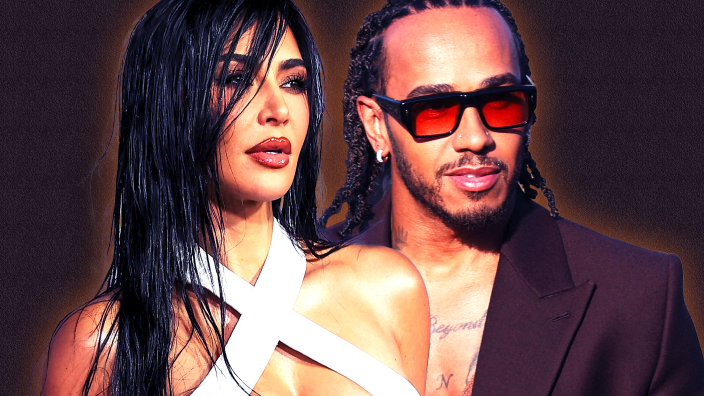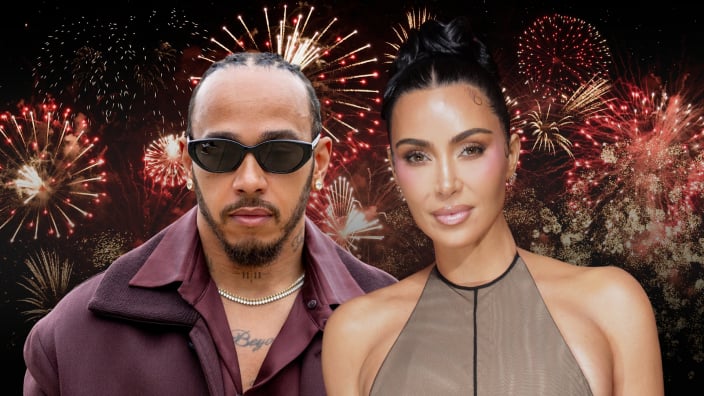
There’s something beautifully absurd about Formula 1 in 2026 — a sport where Kimi Antonelli just became the youngest pole-sitter in history and Mercedes are dominating with revolutionary active aerodynamics — suddenly holding its breath for Kim Kardashian to grace the Miami paddock with her presence. The irony writes itself: while actual racing has never been more technically fascinating, the sport’s marketing apparatus appears convinced that salvation lies not in explaining energy deployment strategies, but in securing the perfect celebrity selfie opportunity.
Reports suggest Kardashian is expected to attend the Miami Grand Prix, and you can practically hear the Liberty Media executives salivating at the prospect of recreating the NFL’s “Taylor Swift effect” — that magical phenomenon where pop culture collides with sport and suddenly everyone’s grandmother knows what a tight end does. The logic, presumably, is that if Swift can make America care about Travis Kelce’s catching statistics, then perhaps Kardashian can make them care about Lewis Hamilton’s championship chances at Ferrari.
The Instagram Grand Prix Strategy
Miami has always been F1’s most shameless attempt at American relevance, a weekend where the racing often feels secondary to the networking opportunities and celebrity sightings. The paddock club transforms into something resembling a high-end music festival, complete with influencer-friendly photo opportunities and enough branded content to power a small social media agency. Adding Kardashian to this mix would essentially complete the transformation from motorsport event to lifestyle experience.
The calculation is depressingly simple: Kardashian commands 364 million Instagram followers, a number that dwarfs F1’s global television audience. Her mere presence generates content that spreads far beyond traditional motorsport circles, potentially reaching demographics that wouldn’t know a DRS zone from a drive-through penalty. Never mind that DRS doesn’t even exist anymore — we have active aerodynamics now, but explaining that requires more than a fifteen-second TikTok clip.
'The car feels completely different with the active aero, it's like driving two different machines depending on the corner.'
— George Russell, explaining 2026 regulations to his engineer
Trading Heritage for Hashtags
What’s genuinely frustrating about this celebrity courtship is the timing. F1 is experiencing one of its most compelling technical revolutions in decades. The 2026 regulations have fundamentally changed how these cars behave, with drivers now managing electrical energy deployment in real-time while adaptive wings morph between corner and straight-line configurations. Mercedes have clearly mastered this new formula, creating a fascinating championship dynamic where technical innovation actually matters again.
Yet here we are, discussing whether a reality TV star’s attendance might somehow validate the sport’s American ambitions. The underlying assumption feels almost insulting to the racing itself — as if wheel-to-wheel combat at 200mph isn’t inherently dramatic enough, we need celebrity endorsement to make it worthwhile.
The NFL comparison reveals the fundamental misunderstanding. Swift’s relationship with Kelce created genuine emotional investment because it was authentic, unexpected, and developed naturally. Manufactured celebrity appearances at F1 races feel like exactly what they are: marketing exercises designed to generate content rather than genuine sporting moments.
The Authenticity Problem
Perhaps the most telling aspect of this celebrity strategy is how it contrasts with F1’s actual growth trajectory. The sport has genuinely expanded its American audience through Netflix’s Drive to Survive, increased race coverage, and the simple fact that the racing has improved dramatically since the ground effect era began in 2022. People are discovering F1 because the product itself is compelling, not because famous people attend races.
There’s also something faintly desperate about chasing the Taylor Swift effect. Swift brought authenticity to NFL coverage because she was genuinely invested in Kelce’s success, learning the sport and celebrating victories with real emotion. Celebrity appearances at F1 races typically involve awkward grid walks, forced interactions with drivers, and photo opportunities that feel more like brand partnerships than sporting enthusiasm.
The real tragedy is that F1 doesn’t need celebrity validation to be relevant. Antonelli’s breakthrough victory in China was genuinely moving — a 19-year-old achieving his childhood dream while his teammate George Russell celebrated alongside him. Hamilton’s renaissance at Ferrari provides compelling narrative drama without requiring external star power. Even Red Bull’s struggles offer fascinating storylines about how quickly fortunes can change in motorsport.
The Miami Circus Continues
If Kardashian does attend Miami, it will undoubtedly generate massive social media engagement and probably introduce F1 to new audiences. That’s not inherently negative — any sport benefits from broader exposure. The concern lies in what gets prioritized: will the coverage focus on racing developments or celebrity reactions? Will the paddock become even more of a VIP networking event than an actual sporting venue?
Miami already pushes these boundaries further than any other race on the calendar. The celebrity attendance often overshadows the actual racing, creating a weekend where the sport feels more like entertainment than competition. Adding Kardashian to this mix would likely push that balance even further toward spectacle.
The ultimate irony is that F1’s authentic moments — the pure sporting drama of wheel-to-wheel racing — remain more compelling than any manufactured celebrity content. Antonelli’s maiden victory, Hamilton’s Ferrari podium, Mercedes’ early-season dominance: these stories resonate because they’re real, not because they’re endorsed by reality TV personalities.
F1 will survive Kim Kardashian’s potential Miami appearance, just as it survived decades of celebrity hangers-on and marketing gimmicks. The racing itself remains the sport’s greatest asset, even if the promotional apparatus occasionally seems to forget that fundamental truth. Sometimes the most revolutionary thing a sport can do is simply trust that its own product is worth watching.