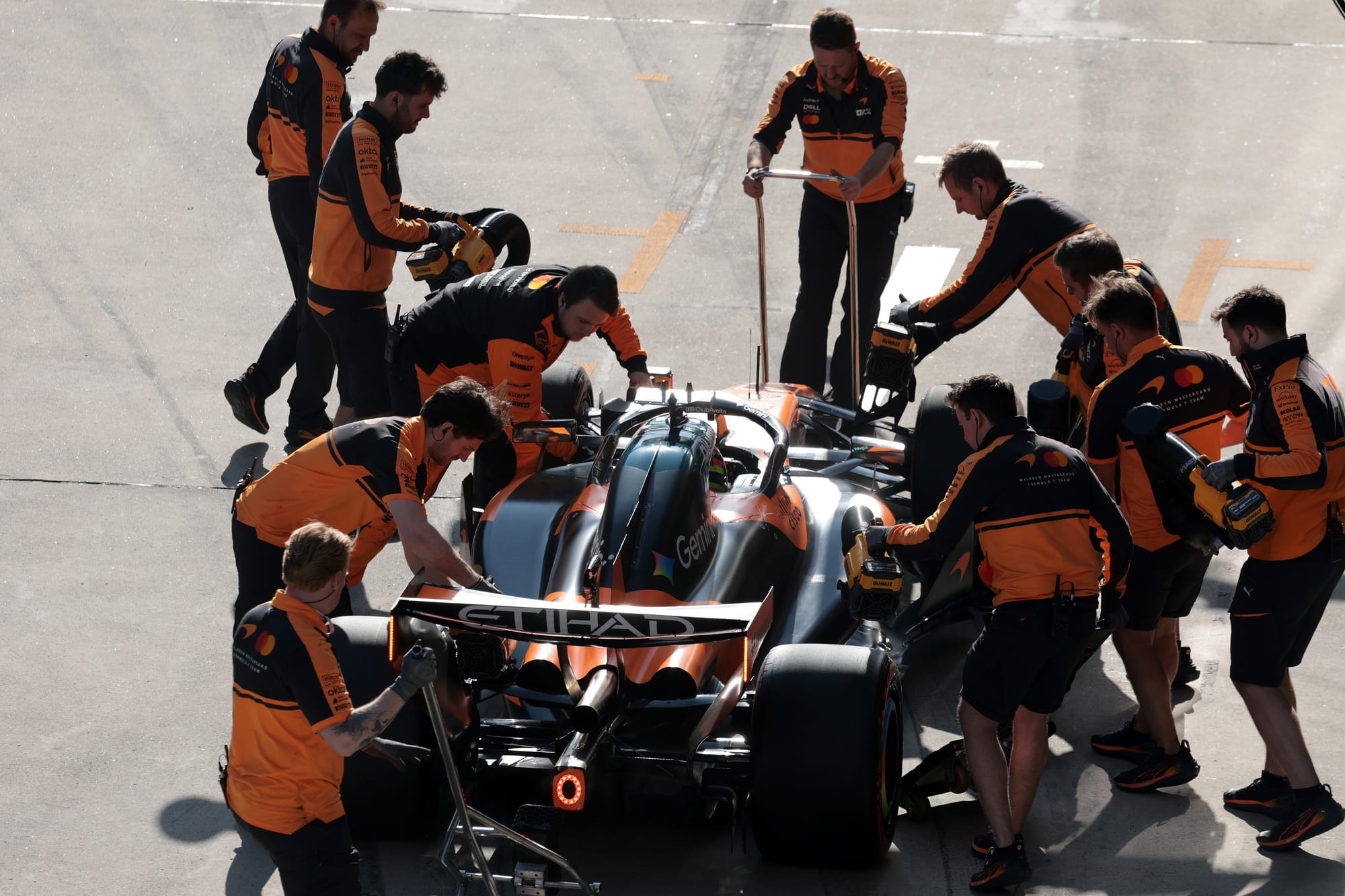
So McLaren, the reigning constructors’ champions, have managed to accumulate a grand total of 18 points from two races. Mercedes, the team whose engine sits in the back of the MCL40, has 98. That’s not a performance gap — that’s an existential crisis wrapped in papaya orange.
But here’s the thing most people get wrong about McLaren’s disastrous start to 2026: it’s not just about reliability. The double DNS in China and Piastri’s grid crash in Melbourne are symptoms of a much deeper structural problem. One that goes to the very heart of how modern Formula 1 works, and one that McLaren — despite being the most successful customer team of the turbo hybrid era — may never fully solve while remaining a customer.
Let’s talk about why.
The Integration Problem
When Mercedes, Ferrari, or Red Bull designed their 2026 cars, they didn’t start with a chassis and then bolt in an engine. They designed both simultaneously. Every cooling duct, every aerodynamic surface, every suspension pickup point was optimized around the specific characteristics of their power unit. The engine and chassis were conceived as one integrated system from day one.
McLaren didn’t get that luxury.
What McLaren got was a power unit, some attachment points, and a general set of guidelines about where things need to go. Think of it like buying an engine for a house you’ve already designed — you can make it fit, but you’ll never achieve the same efficiency as someone who designed the house around the engine from scratch.
This matters more in 2026 than in any previous regulation era. The new rules — with their 50/50 electrical-to-combustion power split, active aerodynamics, and flat-floor cars — have created a situation where the interaction between power unit and chassis is more critical than ever. The aerodynamic drag your car produces directly affects how the engine performs. The cooling requirements of the more powerful MGU-K system influence your bodywork design. Everything is interconnected.
McLaren does have one advantage over Williams and Alpine, the other Mercedes customers: they build their own gearbox. That gives them more freedom in the rear-end packaging of the car. But it also means more integration complexity — more variables to optimize with less information about the power unit’s full capabilities.
The Exploitation Gap
Here’s where it gets really uncomfortable for McLaren. Even if you have the same engine hardware, you don’t have the same knowledge about how to use it.
Mercedes has spent years developing the software, energy deployment strategies, and operational understanding of their power unit. They know exactly when to deploy electrical energy, how aggressively they can push the battery, and how to manage the thermal characteristics of every component. Their drivers get power delivered at precisely the right moment — not too early (which causes wheelspin), not too late (which costs straight-line speed), but exactly when the rear tires reach maximum grip.
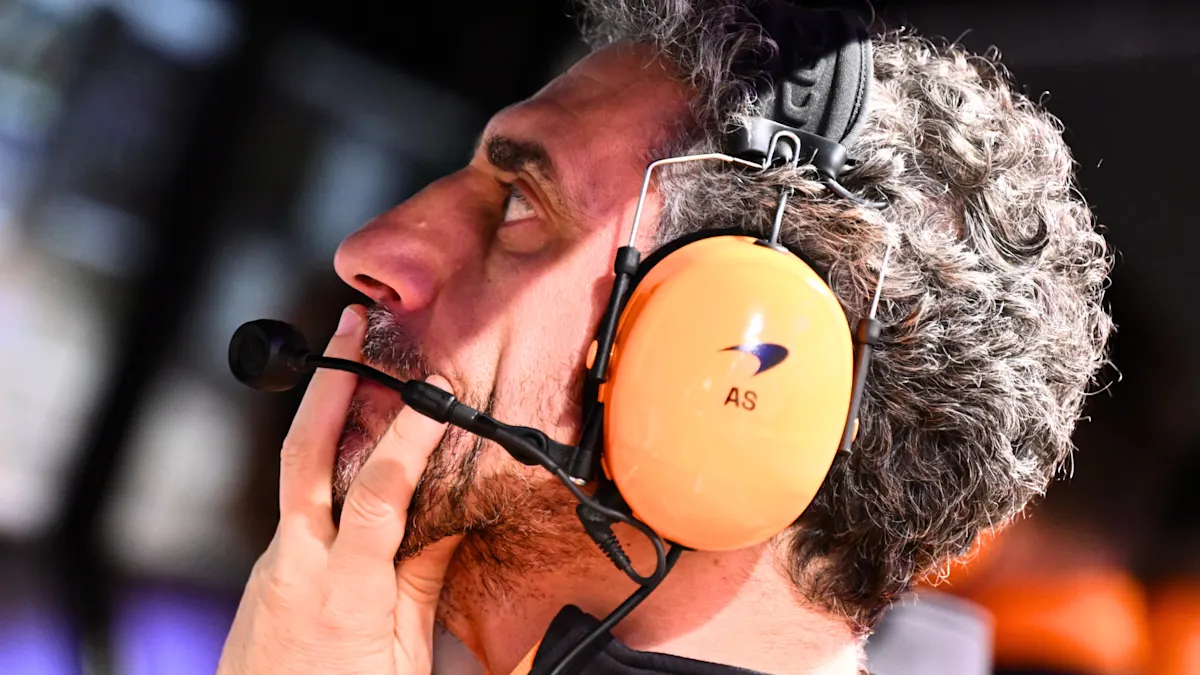
As Andrea Stella himself admitted after Australia: they’re still learning. McLaren is collecting data, running simulations, and reacting to what they find. Mercedes already knows. That difference in understanding — between discovering and knowing — is worth several tenths of a second per lap.
The regulations require Mercedes to supply identical hardware to all customers. Same specification, same components. But there’s no rule that says Mercedes has to share its operational expertise. The deployment maps, the energy management strategies, the accumulated wisdom from thousands of hours of dyno testing — that knowledge stays in Brixworth.
This isn’t Mercedes being malicious. It’s simply the reality of competition. Why would you hand your competitor the instruction manual for beating you?
The Petronas Timebomb
Now let’s add another layer of complexity, because McLaren’s situation wasn’t already complicated enough.
Petronas, the Malaysian petroleum giant that supplies the sustainable fuel for all Mercedes-powered cars, has a problem: producing enough fuel for four teams is not sustainable at the current rate. We’re talking roughly 48,000 liters per season across four operations. Petronas stockpiled enough to cover the initial transition to 100% sustainable fuels, but maintaining that production volume year after year for four teams isn’t viable.
McLaren’s fuel contract with Petronas expires at the end of 2026. And the word in the paddock is that McLaren may not have an option clause for the fuel supply in their Mercedes engine agreement, which runs until 2030.
So McLaren could find themselves in the absurd position of having a Mercedes engine contract but no compatible fuel. They’d need to find an alternative supplier — companies like Highly Innovative Fuels (backed by Porsche) could be an option — and then invest in R&D to ensure that fuel works optimally with the Mercedes architecture. It’s not insurmountable, but it’s yet another variable, another distraction, another resource drain for a team trying to defend two world championships.
The Bigger Picture: Why Customer Teams Hit a Ceiling
McLaren’s predicament illustrates something fundamental about the economics of modern F1. Being an engine customer works brilliantly in certain circumstances — specifically, at the end of a regulation cycle.
Think about it. In the final years of the previous regulations (2024-2025), engine performance had converged. Every manufacturer had spent nearly a decade refining their power units. The differences were marginal. In that environment, a team with a brilliant chassis — like McLaren — could absolutely dominate. The engine was a commodity; the chassis was the differentiator. That’s exactly how McLaren won two consecutive constructors’ titles.
But at the start of a new regulation cycle? Everything resets. The engine becomes the single most important differentiating factor again. And the teams that built their own engines have an inherent, structural advantage over those who bought them.
Red Bull understood this. After years of being at Renault’s mercy, they invested billions to create Red Bull Powertrains with Ford. It hasn’t been smooth — Verstappen has 8 points and called the car “undriveable” — but the long-term strategic logic is sound.
Audi understood this too. They bought an entire team (Sauber) and are building everything in-house. Mattia Binotto talks about “dozens of projects” needed to reach the summit. It will take time, but they own their destiny.
Aston Martin took the Honda route, partnering with a manufacturer dedicated exclusively to their operation. It’s risky — McLaren’s 2015-2017 Honda nightmare is a cautionary tale — but at least the engine supplier isn’t simultaneously trying to beat you on track.
The Mercedes Model and F1’s Future
Toto Wolff is reportedly reconsidering whether supplying three customer teams makes strategic sense for Mercedes. The operational burden is significant — HPP had to produce sixteen engines just for the Australian Grand Prix to ensure every team had spares. When Honda can barely keep two cars running and Audi is struggling with reliability for a single operation, the scale of Mercedes’ commitment to its customers becomes apparent.
The smart money says Mercedes will reduce its customer base after 2030. Which leaves McLaren with a choice that could define the next decade of the team’s existence.
Option one: find a new manufacturer partner. Someone willing to enter F1 through a partnership model — supplying engines while McLaren handles the chassis. Toyota, through their expanding relationship with Haas, might be playing exactly this game. Others may emerge.
Option two: continue as a customer, accept the structural ceiling, and hope to compete through chassis excellence in the later years of each regulation cycle. It worked before. It could work again. But it means accepting periods of irrelevance at the start of each new era.
Option three: something more radical. The McLaren Group’s valuation has skyrocketed in recent years. Selling a stake to a manufacturer who wants F1 exposure — similar to how Mercedes is structured with a three-way split between the automaker, Toto Wolff’s holding, and INEOS — could bring both capital and technical capability.
The Bottom Line
McLaren’s 2026 struggles aren’t a crisis of talent or ambition. Stella’s operation proved across 2024-2025 that they can build a championship-winning car. Norris and Piastri are among the best driver pairings on the grid.
The crisis is structural. In an era where the power unit dictates performance more than ever, being dependent on a competitor for your most important component is a fundamental competitive disadvantage. You’re always integrating second-hand, always learning second-hand, always racing with one hand tied behind your back.
Eighty points behind after two races. It’s early, the season is long, and McLaren will improve as they learn the Mercedes power unit. They might even win a race this year. But the championship? That’s a conversation for the end of this regulation cycle, when the playing field levels again.
Unless, of course, McLaren decides to stop playing by someone else’s rules entirely. And that decision — more than any upgrade package or strategy call — could be the most important one the team makes this decade.