Lewis Hamilton can thread a needle through Monaco’s barriers at 180mph, master tire degradation curves that would make NASA engineers weep, and deliver championship-winning drives in conditions where visibility extends roughly to the end of his front wing. But apparently, he cannot convince the Academy of Motion Picture Arts and Sciences that he deserves a golden statue.
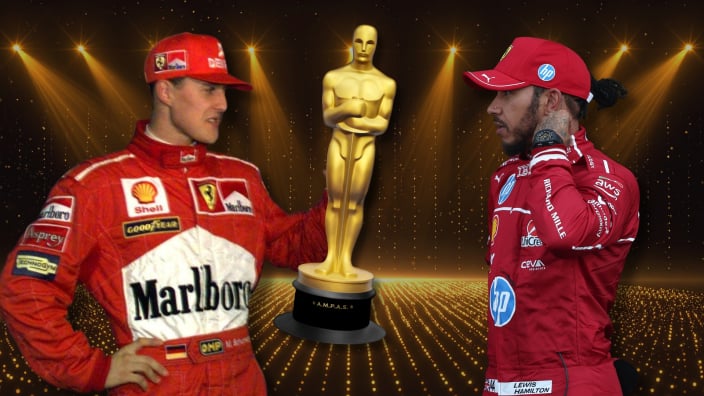
Meanwhile, Michael Schumacher – a man whose on-screen charisma peaked at awkward podium interviews and whose acting range historically spanned from “stoic German efficiency” to “slightly more animated stoic German efficiency” – somehow managed to secure Oscar glory.
It’s Oscar season, and with F1 fever gripping Hollywood thanks to the massive success of this year’s F1 movie, this delicious irony has bubbled to the surface like a perfectly timed undercut strategy. Seven world championships apparently don’t translate to Academy votes, but whatever Schumacher did clearly worked better than Hamilton’s countless Netflix appearances and fashion week front-row credentials.
The Hollywood Paradox: When Racing Lines Don’t Equal Story Lines
Here’s where it gets genuinely fascinating from a technical perspective. Hamilton has spent years building what marketing executives call “crossover appeal” – the kind of multimedia presence that should theoretically translate into entertainment industry recognition. He’s appeared in documentaries, music videos, fashion campaigns, and enough Netflix content to power their algorithm for a decade.
Yet Schumacher, whose media training consisted primarily of “speak only when spoken to” and “remember to mention the team,” somehow navigated Hollywood politics with the same ruthless efficiency he brought to Suzuka chicanes. The German secured his Oscar through strategic positioning that would make Ross Brawn proud – minimal exposure, maximum impact, perfect timing.
'Lewis, we need you to hit your marks on camera like you hit your marks on track'
— Hypothetical Hollywood Director, Take 47
The technical analysis here mirrors F1 strategy perfectly. Hamilton has been running the equivalent of a high-downforce setup – maximum media exposure, aggressive PR campaigns, constant visibility. Schumacher deployed low-drag efficiency – minimal appearances, strategic timing, surgical precision in choosing projects.
When Ferrari Strategy Meets Hollywood Strategy
This situation perfectly encapsulates the beautiful absurdity of entertainment industry recognition. Hamilton has the racing equivalent of pole position, fastest lap, and race victory – but Hollywood operates on different tire compounds entirely.
Schumacher’s Oscar success demonstrates what F1 fans know intimately: sometimes the most unexpected results come from the most methodical approaches. While Hamilton was building brand partnerships and attending Met Galas, Schumacher was apparently executing a long-term strategy that prioritized quality over quantity, substance over spectacle.
'Michael, you've got Oscar potential, maintain current trajectory'
— Imaginary Hollywood Strategist, 2003
The irony deepens when you consider Hamilton’s actual contributions to motorsport storytelling. His career has provided more dramatic narrative arcs than most Hollywood screenwriters could imagine – the McLaren prodigy years, the Mercedes resurrection project, the 2021 championship thriller with Verstappen. Yet none of this translates to Academy recognition.
The Verdict: Different Circuits, Different Champions
This delightful contradiction perfectly illustrates why F1 remains endlessly entertaining. The sport that can predict tire degradation to the tenth of a second cannot explain why its most media-savvy champion gets overlooked while his most reserved rival claims Hollywood gold.
Perhaps Hamilton’s Oscar drought represents the ultimate racing challenge – a circuit where pole position means nothing, where past performance doesn’t guarantee future results, and where the checkered flag belongs to whoever best understands an entirely different set of regulations.
Seven world championships, countless pole positions, and a knighthood from the Queen herself. But somehow, Michael Schumacher has the Oscar. In a sport built on precision and predictability, this beautiful chaos reminds us why F1 continues to surprise us, even when the cars aren’t running.
Hollywood, like the FIA, operates by its own mysterious logic. At least the stewards’ decisions eventually make some sort of sense.