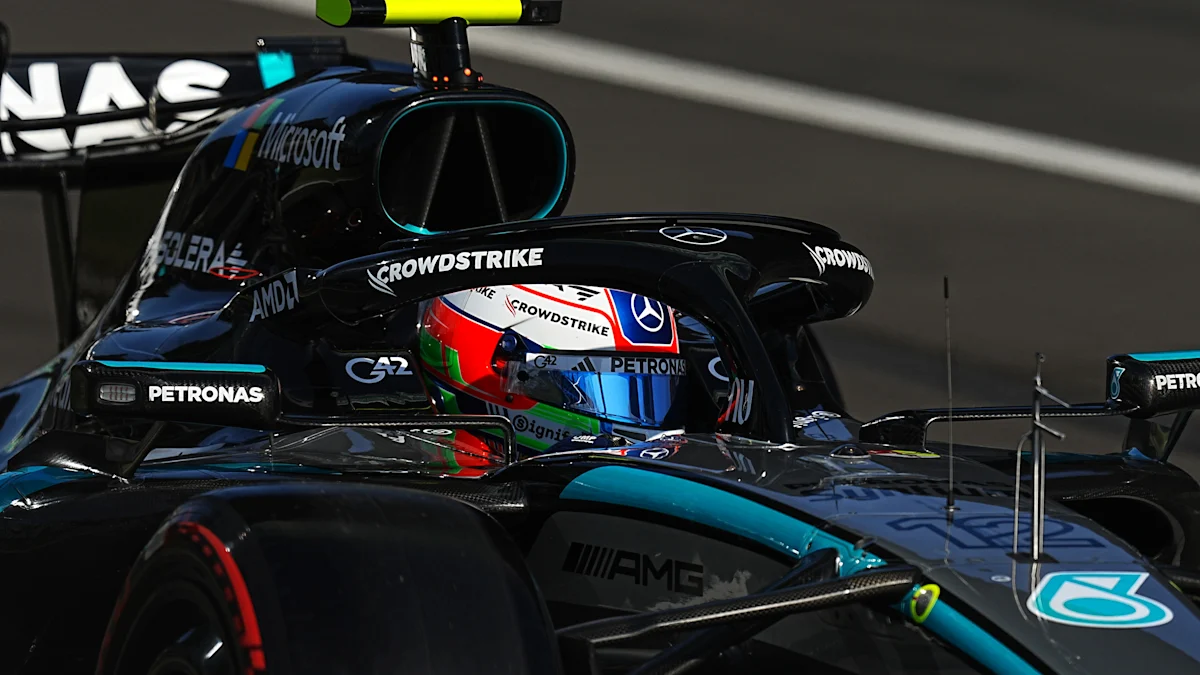
George Russell’s Chinese Grand Prix weekend was going about as smoothly as a Ferrari strategy meeting when Mercedes engineers discovered something revolutionary: the power button. Yes, that’s right. In a sport where teams burn through budgets that could fund small nations developing quantum computing solutions and aerodynamic wizardry, the Silver Arrows solved their £200 million car’s problems with humanity’s greatest technological breakthrough since fire.
Russell’s W17 had been throwing more error codes than a Windows 95 machine running Crysis, with telemetry readings that made absolutely zero sense and systems behaving like they’d been possessed by the ghost of reliability past. The car was essentially having what can only be described as a complete electronic nervous breakdown, which in F1 terms means you’re about as competitive as a shopping trolley with a wonky wheel.
When High-Tech Meets No-Tech
The Mercedes garage had become a scene from a tech thriller, with engineers frantically cross-referencing data streams, checking sensor calibrations, and presumably Googling “why is my F1 car acting like my printer.” The power unit was reporting conflicting temperatures, the ERS system was having an identity crisis, and the suspension sensors were providing readings that suggested Russell was either driving through a portal to another dimension or the car had developed severe trust issues.
After hours of sophisticated diagnostics involving equipment that costs more than most people’s houses, someone—presumably the team’s most junior engineer who still remembered their university IT helpdesk days—suggested the nuclear option: a complete system reboot.
'George, we need you to park up and turn everything off for thirty seconds. Yes, everything. No, this isn't a joke. Yes, we're serious. Just... trust the process.'
— Mercedes Engineer, channeling their inner IT support
The technical explanation, for those who appreciate the beautiful irony, involves what’s essentially a memory leak in the car’s Electronic Control Units (ECUs). Modern F1 cars run on approximately 150 ECUs managing everything from power unit deployment to suspension settings, all communicating through high-speed CAN bus networks. When these systems get overwhelmed with conflicting data packets—often caused by sensor noise or electromagnetic interference from the hybrid systems—they can enter what engineers politely call “undefined behavior states.”
The £200 Million Ctrl+Alt+Del
What makes this particularly delicious is the context. Mercedes has spent the winter developing new machine learning algorithms to optimize their power unit maps in real-time, created bespoke simulation software that can model airflow with quantum-level precision, and engineered suspension systems that make NASA’s Mars rovers look primitive. Yet their weekend was saved by the same solution your grandmother uses when her iPad stops working.
The reboot process in F1 is actually more complex than your average laptop restart—it involves shutting down the hybrid systems in a specific sequence to avoid damaging the MGU-K or causing electrical feedback through the high-voltage systems. The power unit has to be completely isolated, all ECUs cleared, and then everything brought back online following a strict protocol that ensures the ERS and combustion engine synchronize properly.
'Right George, everything's back online. All systems showing green. How does she feel?'
— Mercedes Engineer, probably crossing their fingers
But here’s the beautiful part: it worked. Russell’s car transformed from electronic disaster to functioning racing machine faster than you could say “have you tried turning it off and on again.” The telemetry started making sense, the systems began talking to each other like civilized pieces of technology, and Russell could finally focus on driving rather than wondering if his car had developed sentience and chosen violence.
The Verdict: Sometimes Simple Wins
This incident perfectly encapsulates modern F1’s beautiful contradiction. Teams employ some of the brightest engineering minds on the planet, develop technology that makes SpaceX look quaint, and then discover that sometimes the most sophisticated solution is the oldest one in the book. It’s like watching a Formula 1 team discover fire—technically impressive in its simplicity, slightly embarrassing in its obviousness, but undeniably effective.
Mercedes might want to add a new role to their pit crew: Chief Turning-It-Off-And-On-Again Officer. Because apparently, even in a sport where milliseconds matter and technology rules supreme, the universal IT solution still reigns supreme. Who knew that the secret to unlocking the W17’s potential was the same technique your office uses to fix the printer?